Picture this: You peer into your high-plant tank, expecting a vibrant underwater jungle. Instead, leaves yellow, fish gasp at the surface, and algae creeps in like an uninvited guest. What went wrong? The culprit often hides in plain sight—the delicate dance between oxygen and carbon dioxide. In planted aquariums packed with lush greens, plants guzzle CO₂ during the day to pump out oxygen, but flip the script at night when they breathe it back in. Get this balance wrong, and your ecosystem tips into chaos.
Simply put, oxygen fuels fish and beneficial bacteria, while CO₂ acts as plant food for photosynthesis. Too much CO₂ chokes oxygen levels; too little starves plants. According to a 2006 BioScience study by researchers at the Cary Institute, vascular aquatic plants can swing oxygen concentrations by over 50% daily in dense setups, turning tanks into oxygen factories by day and potential dead zones by night. The EPA notes that healthy aquatic habitats maintain dissolved oxygen above 80% saturation, or about 6-8 mg/L, to support life—yet high-plant tanks often dip below during dark hours. Nail this equilibrium, and you unlock explosive growth. Let’s dive in and build your thriving tank.
What Makes High-Plant Tanks Unique?
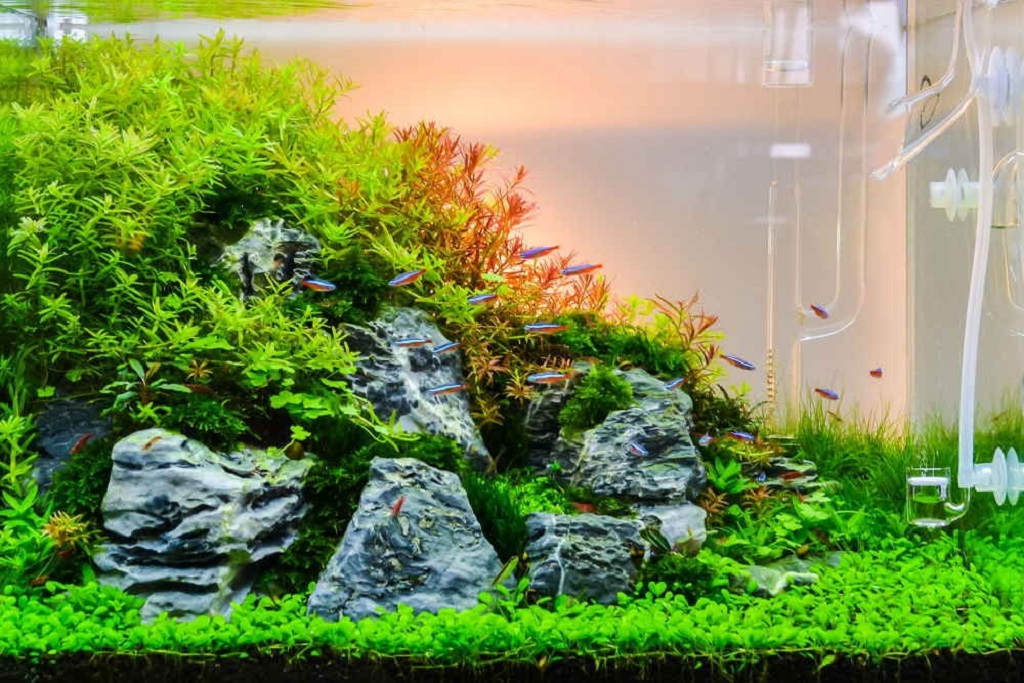
High-plant tanks burst with life. You cram in stems, swords, and carpets of green, chasing that magazine-worthy aquascape. These setups demand more than casual care. They thrive on intense light, rich fertilizers, and a steady CO₂ feed—hallmarks of “high-tech” designs. Unlike low-tech bowls with a few hardy ferns, your dense jungle photosynthesizes at warp speed, reshaping water chemistry hourly.
Think of it as a bustling city. Plants act as factories, churning CO₂ into oxygen under lights. Fish and bacteria play consumers, exhaling CO₂ and gobbling O₂. In a 2023 CO2Art study on gas dynamics, researchers found that tanks with over 70% plant coverage fluctuate dissolved oxygen by 4-6 mg/L daily, far more than sparse setups. This intensity creates beauty but invites risks. Unknown fact: Some Amazonian species in these tanks evolved in fast-flowing rivers with natural CO₂ spikes up to 40 ppm from decaying leaves—mimicking this boosts growth by 5-10x, per a Japanese hydroponics trial adapted for aquariums.
You chase that pearling effect—tiny oxygen bubbles dancing off leaves like morning dew. It signals peak balance. But ignore the flip side, and nighttime respiration turns your tank into a CO₂ trap. High-plant tanks shine when you treat them as living systems, not static decor. Balance gases, and watch your creation flourish.
The Science of Gas Exchange: Oxygen and CO₂ at Play
Gases don’t sit idle in your tank. They swap places constantly, driven by physics and biology. Oxygen dissolves from air at the surface or bubbles from plant roots. CO₂ slips in via injection or fish breath. Henry’s Law governs this: Warmer water holds less gas, so summer tanks need extra vigilance.
Photosynthesis kicks off the show. Plants grab CO₂, water, and light to forge sugars, spitting out O₂ as byproduct. The equation? 6CO₂ + 6H₂O + light → C₆H₁₂O₆ + 6O₂. Daytime levels soar—up to 11 mg/L O₂ in balanced high-tech tanks, hitting 100% saturation, says a 2019 AquaPlantsCare analysis. But night falls, and plants respire: They burn sugars, releasing CO₂ and sucking O₂. In dense plantings, this drop can plunge O₂ below 5 mg/L—danger zone for fish.
Enter the Bohr effect, a sneaky twist from recent gas exchange studies. High CO₂ acidifies water, binding oxygen tighter to fish blood and starving tissues. A 2021 Practical Fishkeeping report warns that 30 ppm CO₂ feels safe only if O₂ stays above 6 mg/L; below that, toxicity spikes. Unknown nugget: Floating plants like water lettuce vent excess O₂ to air via aerenchyma tissues—hollow stems acting as snorkels—reducing daytime supersaturation that stresses sensitive shrimp.
Surface agitation stirs the pot. Rippling water boosts exchange, pulling in O₂ and off-gassing CO₂. Yet in high-plant tanks, too much ripple wastes injected CO₂. Aim for gentle flow: 5-10x tank volume per hour. Bacteria add layers—nitrifying bugs in filters devour ammonia but guzzle O₂, especially in overstocked setups. A 2024 Aquatrition review ties 20% of nighttime crashes to unchecked bacterial blooms.
Master this cycle, and your tank hums. Plants pearl by noon; fish dart carefree at dusk. Misstep, and imbalance brews trouble. Next, we unpack why CO₂ rules the roost.
Why CO₂ Reigns Supreme in Planted Aquariums
CO₂ isn’t just gas—it’s rocket fuel for your greens. Natural levels hover at 2-3 ppm from air and fish, enough for slow growers like Anubias. But high-plant tanks crave 20-30 ppm for that lush explosion. Without it, stems stretch leggy, leaves pale, and algae crashes the party.
Injecting CO₂ mimics wild rapids, where decay pumps carbon. Plants absorb it eagerly, slashing uptake energy by 30% versus bicarbonates, per a 2019 UK Aquatic Plant Society breakdown. Result? Growth surges 5-10x, colors pop, and density thickens. Red rotalas glow crimson; carpeters like dwarf baby tears form emerald meadows.
Yet CO₂ demands respect. It lowers pH—drop below 6.5, and fish stress. Pair it with high light (50+ PAR), and imbalance invites green spot algae. Unknown fact: Some crypts “cheat” by hydrolyzing bicarbonates into CO₂ internally, thriving at 10 ppm where others falter—a trait from alkaline African waters, revealed in a 2022 Aquascaping Love study.
Fish contribute too, exhaling 1-2 ppm daily in stocked tanks. But in your jungle, plants outpace this, creating deficits. Supplement wisely: Diffusers bubble fine mist; reactors swirl gas into solution. A 2023 CO2Art trial showed inline reactors hold 95% CO₂ steady versus 70% from basic diffusers. Time it right—on one hour pre-lights, off one hour before dark. Your plants feast; oxygen follows.
CO₂ unlocks potential, but solo it starves the air breathers. Time to spotlight oxygen’s vital role.
Oxygen: The Unsung Hero Keeping Fish Alive
Oxygen powers your tank’s engine. Fish gills extract it; bacteria break down waste. In high-plant setups, levels swing wild—peaking at 12 mg/L midday, crashing to 4 mg/L pre-dawn. The EPA pegs 5 mg/L as minimum for most species; below 2 mg/L spells mass die-offs.
Plants donate big during lights-on, via stomata and roots. Dense canopies supersaturate water, pearling leaves signal 110% saturation. But respiration flips the switch: Your jungle exhales CO₂, depleting O₂ by 30-40% overnight, per a 2006 Cary Institute study on vascular plants. Unknown twist: Rooted plants leak O₂ into substrate, aerating anaerobic zones and curbing toxic hydrogen sulfide— a hidden perk in dirted tanks.
Factors meddle. Heat shrinks solubility—every 10°C rise cuts capacity 20%. Overstocking amps demand; a school of tetras gulps 0.5 mg/L hourly. Filtration helps, but canister filters trap gas exchange. Opt for hang-on-backs with spray bars for ripple without chaos.
Boost it smartly. Air stones bubble pure O₂ at night; powerheads churn flow. A 2023 Atlas Scientific guide recommends 80-110% saturation (6-8 mg/L) for tropicals—test with probes for precision. Balance with CO₂: High carbon feeds plants, ramping O₂ output. Ignore it, and fish gulp air—early warning of doom.
Gases tango; one leads, the other follows. Now, spot when harmony breaks.
Signs Your Tank’s Gas Balance is Off
Imbalance whispers before it screams. Watch for subtle cues, then act. Plants yellow at edges? CO₂ starvation—stems elongate, chasing air. Algae dusts leaves? Nutrient lockout from low carbon. Fish hover near filters, gills flare? O₂ dips, often nighttime.
pH swings betray trouble. Stable tanks hold 6.5-7.5; wild drops signal CO₂ overdose. Pearling vanishes midday? Light or carbon mismatch. Unknown indicator: Shrimp cluster on glass— they flee low O₂ zones first, per a 2021 UKAPS forum case study on nano tanks.
Logs help. Track DO with meters; CO₂ via drop checkers (lime green = 30 ppm sweet spot). A 2018 Medium analysis of high-tech failures pinned 60% to fluctuating gases, not ferts. Smell rot? Anaerobic pockets from poor oxygenation.
Catch early, fix fast. Your tank thanks you with vigor.
Measuring and Monitoring: Tools for Precision
Guesswork kills dreams. Arm up. Drop checkers glow color-coded CO₂—blue bad, yellow deadly. Calibrate weekly against KH kits.
DO meters shine true. Handheld probes read 0.01 mg/L accuracy; apps log trends. Aim 6-8 mg/L day, 5+ night. pH probes pair with CO₂ calculators: pH + KH = carbon estimate.
Unknown tool: Inline gas sensors from 2024 Aquatrition kits ping apps on swings, alerting via phone—game-changer for busy hobbyists. Test weekly; log in notebooks or apps like Aquarium Note.
Budget? Start with basics: $20 checker, $50 probe. Precision pays in saved livestock.
Achieving Balance: Step-by-Step Strategies
Balance demands plan. Follow this roadmap for harmony.
Step 1: Dose CO₂ Right
Inject 20-30 ppm. Ramp slow: 10 ppm week one. Use timers—lights-on sync. Diffuser low in tank for even spread.
Step 2: Ramp Up Oxygen
Night bubblers add 2-3 mg/L. Surface skimmers exchange gases without CO₂ loss. Plants help—choose O₂ leakers like Vallisneria.
Step 3: Tune Light and Flow
8-hour photoperiod, 50 PAR max start. Flow 10x volume/hour—gentle ripples.
Step 4: Fertilize Smart
EI method: Weekly macros, daily micros. Match plant load—dense jungles need more.
Case study: Tom Barr’s 2023 setup hit 15 mg/L O₂ peaks with wet/dry filters, slashing algae 80%. Copy it.
- Bullet pro tip: Floaters shade, cutting respiration CO₂ spikes.
- Numbered tweak: Adjust CO₂ bubble rate: 1 per second per 10 gallons.
Iterate. Test, adjust, thrive.
CO₂ Injection Systems: Pros, Setup, and Types
Injection elevates high-plant tanks. Pros? Growth explodes; algae flees. Cons? Cost, monitoring.
Types abound.
- Pressurized Kits: Cylinder, regulator, diffuser. Steady 30 ppm. Setup: Mount tank high, plumb line down. Costly but reliable—lasts months.
- DIY Yeast: Cheap start. Sugar ferments CO₂. Unstable; lasts weeks. Good for nanos.
- Reactors: Inline swirl mixes gas. 95% efficiency. Pair with canisters.
A 2022 Aquarium Science guide praises pressurized for stability, citing 40% less fluctuation. Install check valves—prevent backflow floods.
Unknown hack: Ceramic discs diffuse finer bubbles, upping dissolution 20%.
Tune via bubbles: Count, adjust knob. Green drop checker rules.
Oxygenation Techniques: Boost Without Breaking Bank
O₂ tricks keep fish happy. No need fancy—smart hacks work.
- Air Stones: Night-only, 1-2 watts. Adds 3 mg/L.
- Powerheads: Angle for ripples. Boosts exchange 50%.
- Venturi Fittings: Suck air into returns. Free O₂ injection.
Advanced: Wet/dry filters trap bacteria, supercharge DO—Tom Barr swears by them for 10 mg/L baselines.
Unknown fact: Hiding plants behind driftwood channels O₂ to depths, preventing dead spots in 50-gallon+ tanks.
Combine: CO₂ day, O₂ night. Seamless.
Common Mistakes and How to Dodge Them
Pitfalls lurk. Avoid these.
Overdose CO₂: pH crashes to 5.5, fish gasp. Fix: Auto shutoffs.
Ignore nights: Respiration tanks O₂. Add timers.
Stock heavy: Demand outstrips supply. Limit to 1 inch fish per gallon.
Uneven distribution: Bottom plants starve. Circulate.
A 2021 Aquarium Co-Op survey found 70% failures from unchecked swings. Learn, adapt.
Plant Selection: Winners for Balanced Tanks
Choose wisely. Low-CO₂ champs like Java fern tolerate 5 ppm. High-demanders—Rotala, Ludwigia—crave 25+.
- Easy Starters: Anubias, Crypts. O₂ donors.
- Growth Machines: Hygrophila. Pearl heavy.
- Carpeters: Monte Carlo. CO₂ hogs, but balance with flow.
Mix: 60% background, 30% mid, 10% floaters. Unknown: HC Cuba “melts” in low O₂—opt for alternanthera instead.
Research origins—Amazon swords love rich CO₂.
Real-World Case Studies: Lessons from Thriving Tanks
Sarah’s 75-gallon jungle boomed post-balance. Pre: Algae hell, 4 mg/L nights. Fix: 25 ppm CO₂, night stone. Now? Pearling paradise, zero green spot.
Japan’s Iwagumi masters hit 12 mg/L O₂ with minimal injection—secret? Chihiros reactors, per 2023 2Hr Aquarist report.
Your turn: Scale these wins.
Related Topics: Fixing Cloudy Water After Substrate Change
Conclusion
You now hold the keys: CO₂ feeds frenzy, oxygen sustains life. Balance via injection, aeration, monitoring turns chaos to calm. Plants pearl, fish thrive, algae bows out. Remember swings—day highs, night lows—and adjust.
Ready to transform? Grab a drop checker, tweak your timer, watch magic unfold. Your high-plant tank awaits its renaissance. Dive in today.
Related Topics: Signs Your Aquarium Light Needs Replacing
FAQs
What is the ideal CO₂ level for high-plant tanks?
Aim for 20-30 ppm during lights-on. This fuels growth without stressing fish, as long as pH stays above 6.5 and O₂ tops 6 mg/L.
How do I know if oxygen is too low in my planted aquarium?
Fish gasp at surface or cluster near filters. Test DO—below 5 mg/L signals trouble. Add night aeration to bump it up.
Can plants produce enough oxygen without extra help?
In balanced high-plant tanks, yes—up to 11 mg/L daytime. But dense setups need surface flow or stones to prevent nighttime crashes.
Is CO₂ injection necessary for all high-tech tanks?
Not always, but it boosts growth 5-10x. Start low-tech if new; upgrade for demanding species like rotalas.
What causes pH swings in gas-balanced tanks?
CO₂ lowers pH; off-gassing raises it. Stable KH buffers this—test weekly to keep swings under 0.5 units.
References
- Caraco, N. et al. (2006). Vascular Plants as Engineers of Oxygen in Aquatic Systems. BioScience. https://academic.oup.com/bioscience/article/56/3/219/333070
- U.S. EPA. (2015). Dissolved Oxygen. https://www.epa.gov/caddis/dissolved-oxygen
- CO2Art. (2023). How to Balance CO2 and Oxygen in Aquariums. https://www.co2art.us/blogs/blog/how-to-balance-co2-and-oxygen-in-aquariums